
- What do you want to see in your young dog before entering him in a trial
- What trial characteristics are you looking for (length of outrun, type of sheep, etc...)
- What adjustments do you make in terms of handling to help your young dog
- Any other relevant information on the topic.
Trialing a Young Dog 3
By John Palmer
(photo credit to Cynthia Palmer)
Before entering a trial with my younger dogs, I want to make sure I have decent control of them. I do want them fairly broke. They don’t have to be perfect, generally do not have pace, but their lie down (at home) is solid and I’ve had them out to a few new places or, at minimum, different fields at our place.
I don’t have an age they need to be, it could range from 1-4 depending on their experience. They need to be responsible in keeping sheep together, not head if there is a draw (within reason) and know that I will help them if they are over their head. If I’m fighting with them at home, they aren’t ready for a new field and new sheep. I want experiences outside of our farm to be positive and constructive.
So when I’m thinking about trialing a young dog and the field/sheep, it really depends on the type of dog. I like being able to see the dog and not set up a young dog for blind or difficult outruns at a trial. But if it is difficult, I hope I have prepared them for redirects! More often it isn’t the field or the sheep, but if I have the time to trial away from the farm. I don’t want to have to fight a difficult field or huge draw on first time trialing. I’m pretty relaxed about the trial location and the type of sheep and will do what is right to help the dog be successful.
Adjustments for a young dog at a trial: I really don’t care where or if I place or RT, just that the dog is trying, listening, and making progress. I’m not fighting with a beginning trial dog just to finish a course and certainly if the sheep are stressed because the dog is not minding I will stop the run. If something isn’t’ working (whistles or flanks) I’ll switch to verbals and try and end on a positive note.
My advice: With young dogs, let them learn, let them develop, don’t take a lot out of them because it is hard to put it back. And each dog is an individual, just because your last dog did “x”, do not think your next dog will also. Have fun out there!
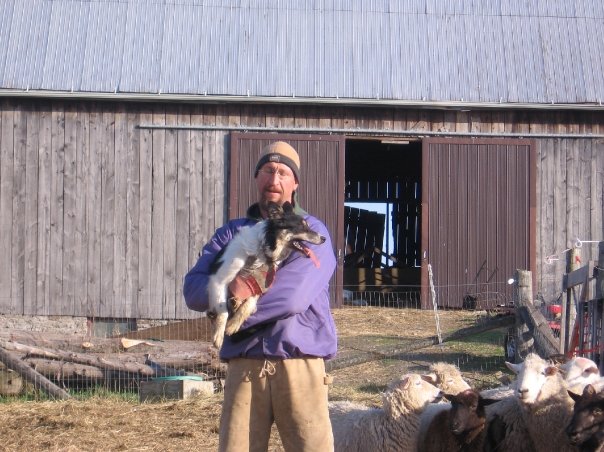
John with one of his youngsters
Started in border collies while working on our home flock. That expanded to working at a farm with about 3500 sheep, mainly pasture based. At that farm I often worked two or three dogs at once and the work was sometimes not so precise. But it was there a couple of my pups got their start. I learned real work with a young dog can be messy and not particularly precise but they learn how to be responsible and to complete a job. I currently run in open with Monk (Alice X Coy) and Demi (Silt X Jock). I have several young dogs that may (or may not) make it to the trial field this year.